
Best Clean Moisturizer for Oily Dehydrated Skin
Table of Contents
- What Is Oily Dehydrated Skin and Why Clean Moisturizers Matter
- Key Ingredients for Oily Dehydrated Skin Moisturizers
- Understanding Clean Beauty Standards in the US
- Top Clean Moisturizers for Oily Dehydrated Skin: Feature Comparison
- Best Clean Moisturizer Picks for Oily Dehydrated Skin
- Building a Skincare Routine for Oily Dehydrated Skin
- How to Choose the Right Clean Moisturizer for Your Skin
- Conclusion: Finding Your Best Clean Moisturizer
Best Clean Moisturizer for Oily Dehydrated Skin
Last Updated: July 30, 2026
Oily, dehydrated skin is a paradox: your complexion produces excess sebum while lacking water content. This requires a clean moisturizer formulated to restore hydration without clogging pores or leaving greasy residue. At Aeran Skincare, we've spent years helping customers navigate this condition by addressing the root cause of dehydration while keeping shine under control.
This guide breaks down the science behind oily dehydrated skin, identifies effective ingredients, and walks you through the best clean moisturizer options and how to layer them into your routine.
What Is Oily Dehydrated Skin and Why Clean Moisturizers Matter
Your skin produces oil (sebum) and retains water independently. Oily dehydrated skin means your skin barrier is compromised, causing transepidermal water loss while your oil glands work overtime to compensate. This happens when the barrier is damaged by over-stripping products, harsh actives, or environmental stress.
The confusion arises because oily skin looks hydrated, it's shiny. But that shine is sebum, not moisture. Heavy creams trap both water and oil, making breakouts worse. A clean moisturizer for oily dehydrated skin uses humectants (water-binding ingredients) and lightweight occlusives that repair the barrier without clogging pores.
Why "clean" matters: conventional moisturizers often contain silicones, synthetic fragrance, or pore-clogging emollients that worsen congestion. Clean formulations focus on barrier repair with minimal irritants.
Oily Dehydrated Skin vs. Dry Skin: Understanding the Difference
Dry skin lacks both oil and water, feels tight, and looks flaky. Oily dehydrated skin has excess sebum but insufficient water content, it feels tight and shiny, often with congestion.
| Characteristic | Oily Dehydrated | Dry Skin |
|---|---|---|
| Oil Production | High (excess sebum) | Low (minimal oil) |
| Water Content | Low (dehydrated) | Low (dehydrated) |
| Texture | Shiny with tight patches | Flaky, rough |
| Best Moisturizer Type | Lightweight gel-cream, water-based | Rich cream, occlusive balm |
| Ingredient Priority | Humectants + light ceramides | Heavy occlusives + emollients |
| Breakout Risk | High with heavy creams | Low |
Treatment paths differ significantly. Dry skin thrives on occlusive-heavy formulas. Oily dehydrated skin needs humectants that pull water in, paired with minimal but essential ceramides to repair the barrier without adding shine.
Key Ingredients for Oily Dehydrated Skin Moisturizers
The best clean moisturizer prioritizes water-binding and barrier-repair components while avoiding pore-clogging emollients.
Hyaluronic acid (sodium hyaluronate) binds up to 1000 times its weight in water, plumping skin and reducing fine lines. It works best in lightweight gels applied to damp skin.
Glycerin draws moisture into the skin and supports the skin barrier. Unlike heavier emollients, it absorbs quickly and doesn't leave a greasy feel.
Ceramides (particularly ceramides NP, AP, and EOP) form the structural foundation of your skin barrier. They're non-comedogenic and essential for repairing a compromised barrier without clogging pores.
Niacinamide (vitamin B3) regulates sebum production while strengthening the skin barrier, one of the few ingredients that directly addresses both oiliness and dehydration.
Aloe vera provides hydration and anti-inflammatory support without heaviness.
Humectants, Occlusives, and Barrier-Repair Ceramides
A well-formulated moisturizer balances three layers without overdoing any single category.
Humectants attract water into the skin. Hyaluronic acid, glycerin, and sorbitol are lightweight and essential for oily dehydrated skin. However, they alone can increase dehydration without an occlusive layer to seal them in.
Occlusives prevent transepidermal water loss. Traditional occlusives (petrolatum, mineral oil) feel greasy on oily skin. Lighter occlusives like squalane and jojoba oil create protection with minimal shine. For oily dehydrated skin, use minimal occlusive content, just enough to seal hydration without clogging pores.
Ceramides and fatty acids are part of your skin's natural barrier structure. They work synergistically with humectants to repair the barrier from within.
The best formulations layer these strategically: humectants first (to pull water in), ceramides second (to repair the barrier), and a minimal occlusive last (to seal everything). This prevents greasiness while delivering real hydration.
Ingredients to Avoid: Non-Comedogenic Formulation Standards
For oily dehydrated skin, certain ingredients worsen congestion and breakouts: heavy oils (coconut oil, mineral oil, lanolin), silicones (dimethicone, cyclomethicone), synthetic fragrance, essential oils, alcohol denat, phthalates, and parabens. The best clean moisturizer explicitly avoids this list. Check labels for "fragrance-free," "silicone-free," and "alcohol-free" claims.
Understanding Clean Beauty Standards in the US
Clean beauty lacks a legal definition in the United States, but several standards have emerged. The FDA regulates cosmetics but doesn't pre-approve ingredients the way pharmaceuticals are reviewed.
Common clean beauty standards include:
- EWG Verification: Tests products against chemicals of concern
- Leaping Bunny Certification: Confirms cruelty-free status
- NSF/ANSI 305: A third-party standard for personal care products
- Dermatologist-tested: Indicates evaluation for safety and efficacy
For oily dehydrated skin, dermatologist-tested formulations that exclude silicones, synthetic fragrance, and common irritants are most relevant. Aeran Skincare's formulations meet these standards, using ceramides and barrier-repair ingredients without fillers that trigger congestion.
Environmental Working Group's guide to clean beauty standards
Top Clean Moisturizers for Oily Dehydrated Skin: Feature Comparison
| Product | Price | Key Ingredients | Best For | Texture |
|---|---|---|---|---|
| Aeran Sensitive Skin Overnight Cream | $28.95 | Ceramides, aloe, algae | Barrier repair | Lightweight cream |
| Aeran Ceramide Barrier Night Cream | $36.00 | Ceramides, fatty acids, aloe | Deep hydration | Rich but absorbs quickly |
| Biossance Squalane + Probiotic Gel | $54.00 | Squalane, probiotics, fermented bisabolol | Oily, sensitive skin | Fast-absorbing gel |
| Youth to the People Superfood Air-Whip | $52.00 | Hyaluronic acid, superfoods, antioxidants | Lightweight hydration | Whipped, airy texture |
| Glow Recipe Watermelon Glow Pink Juice | $39.00 | Watermelon extract, hyaluronic acid | Oil-free hydration | Cooling gel-emulsion |
Best Clean Moisturizer Picks for Oily Dehydrated Skin
Aeran Sensitive Skin Overnight Cream: Barrier-First Approach
The Aeran Sensitive Skin Overnight Cream ($28.95) is purpose-built for compromised barriers. It combines aloe vera, algae extract, and ceramides in a lightweight formula that absorbs fully without leaving residue. This is the best choice if your priority is barrier repair without congestion risk.
The formula uses aloe juice as a primary ingredient for hydration and anti-inflammatory support, with algae extract adding minerals and trace elements. Ceramides address the root cause of dehydration. There's no fragrance, silicones, or unnecessary emollients.
For someone with oily dehydrated skin and active irritation or redness, this is the safest entry point. Give it two weeks before deciding if the functional texture works for you.
Aeran Ceramide Barrier Night Cream: Repair and Hydration
The Aeran Ceramide Barrier Night Cream ($36.00) delivers higher ceramide concentration for more severe barrier damage. Fatty acids support the ceramide matrix, creating comprehensive barrier repair. Aloe provides hydration and soothing properties. The formula absorbs fully within 10-15 minutes.
Best for evening use, especially layered over a hydrating serum. The slightly richer texture supports overnight barrier repair without interfering with morning makeup.
Lightweight Gel-Cream Alternatives: Oil-Free Hydration
Glow Recipe Watermelon Glow Pink Juice Moisturizer ($39.00) is 100% oil-free, cooling, and matte-finishing. Ideal for warm climates or summer months.
Youth to the People Superfood Air-Whip Moisture Cream ($52.00) uses an air-whipped texture with hyaluronic acid and antioxidants. Better for maintenance than active barrier compromise.
Biossance Squalane + Probiotic Gel Moisturizer ($54.00) combines plant-derived squalane with encapsulated probiotics for microbiome balance. A strong choice if balancing oil production while hydrating is your priority.
For most people with oily dehydrated skin, Aeran's offerings deliver better value and more targeted barrier repair.
Building a Skincare Routine for Oily Dehydrated Skin
A clean moisturizer is only half the equation. How you layer products determines whether hydration reaches your skin or sits on the surface.
Apply products from thinnest to thickest consistency on damp skin. Water acts as a delivery vehicle for humectants. If you apply moisturizer to completely dry skin, humectants have nothing to bind to.
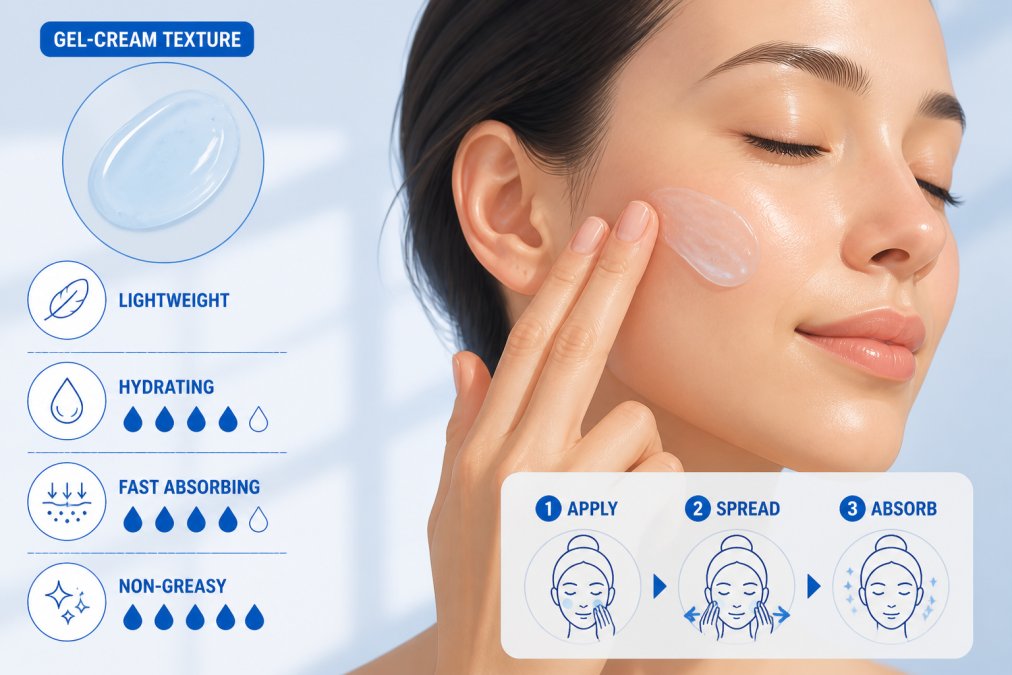
Step 1: Cleanse with a gentle, non-stripping cleanser. Avoid foaming cleansers and sulfates. A cream or micellar cleanser removes oil without disrupting the barrier.
Step 2: Apply a hydrating toner. The Aeran Hydrating Toner with Rose Water & Hyaluronic Acid ($26.00) preps skin by adding water and pH-balancing. Pat it in rather than rubbing.
Step 3: Apply a hydrating serum or essence. The Bioactive Prebiotics Jelly Serum ($58.00) nourishes the skin microbiome while hydrating. Apply while skin is still slightly damp.
Step 4: Apply your moisturizer. While skin is still damp, apply either the Sensitive Skin Overnight Cream or Ceramide Barrier Night Cream. Moisture will be sealed in by the ceramides and light occlusives.
Step 5: Optional, seal with a minimal occlusive. If your barrier is severely compromised, a tiny amount of squalane can seal everything in. For most oily dehydrated skin, the moisturizer alone is sufficient.
Morning vs. Evening Layering Strategies
Morning Routine:
- Gentle cleanser
- Hydrating toner
- Lightweight serum (optional)
- Aeran Sensitive Skin Overnight Cream or lighter gel-moisturizer
- Sunscreen (SPF 30+)
The morning routine prioritizes speed and makeup compatibility. The Sensitive Skin Overnight Cream absorbs fully in 5 minutes.
Evening Routine:
- Gentle cleanser
- Hydrating toner
- Bioactive Prebiotics Jelly Serum
- Aeran Ceramide Barrier Night Cream
- Optional: minimal facial oil (squalane) if barrier damage is severe
Evening allows richer formulations. The Ceramide Barrier Night Cream delivers more barrier support and has time to fully absorb.
How to Layer Hydrating Toners, Serums, and Moisturizers
The 10-Second Rule: Wait 10-15 seconds between each product application so each layer absorbs partially before the next layer is applied.
Application technique:
- Apply toner with your hands (patting, not rubbing)
- Wait 10 seconds
- Apply serum in small dots and gently press in
- Wait 10 seconds
- Apply moisturizer in upward strokes, focusing on congestion-prone (T-zone) and dry areas (cheeks, around eyes)
Quantity matters: Use about a nickel-sized amount of moisturizer for your entire face. More is not better.
For oily dehydrated skin: Use less serum and toner than you would for dry skin. If products feel heavy after layering, you're using too much.
The "feathering" technique: Apply moisturizer most densely on dry areas and feather it lightly across the T-zone to prevent congestion while ensuring adequate moisture.
Dermatology research on transepidermal water loss and barrier function
How to Choose the Right Clean Moisturizer for Your Skin
Start with barrier damage severity: If your skin is actively irritated, red, or stinging, begin with the Aeran Sensitive Skin Overnight Cream. If your barrier is mildly compromised, either Aeran formula works.
Consider your climate: In humid climates or summer, opt for gel-creams. In dry climates or winter, the richer Aeran Ceramide formula offers better protection.
Test for ingredient sensitivities: If you've reacted to aloe before, skip Aeran formulas. If you're sensitive to squalane, avoid Biossance. Identify your specific triggers and cross-reference ingredient lists.
Evaluate absorption rate: Apply a small amount to your inner arm. All Aeran formulas absorb within 10 minutes; gel-creams absorb in 2-3 minutes. For oily dehydrated skin, aim for 5-10 minute absorption.
Evaluating Absorption Rate and Ingredient Transparency
Absorption rate predicts how a moisturizer will feel on your skin. Fast absorption (under 5 minutes) suggests lightweight formulation with minimal occlusive content. Slow absorption (over 15 minutes) suggests a richer formula better suited for dry skin.
Check for:
- Ceramide specificity: Does the label list ceramide types (NP, AP, EOP)?
- Hyaluronic acid source: Is it sodium hyaluronate (stable) or hyaluronic acid (less stable)?
- Preservative system: Are preservatives listed? Clean formulas use gentle systems like phenoxyethanol.
- Water content: Is water (aqua) the first ingredient?
Aeran Skincare's ingredient lists meet these standards, specifying ceramide types and using sodium hyaluronate. The company publishes full ingredient lists on product pages.
Finding the best clean moisturizer for oily dehydrated skin requires understanding your barrier damage, selecting ceramide-forward formulations, and layering them strategically on damp skin. Aeran Skincare's Sensitive Skin Overnight Cream and Ceramide Barrier Night Cream both deliver visible barrier repair without silicones, synthetic fragrance, and pore-clogging ingredients. Start with the Sensitive Skin formula if your barrier is actively compromised, then transition to the Ceramide Night Cream for maintenance and intensive overnight repair. Pair either with the Hydrating Toner and Bioactive Prebiotics Serum for a complete routine that addresses both dehydration and oil imbalance. Your skin barrier repairs itself, it just needs the right ingredients to do it.
Frequently Asked Questions
What ingredients should I look for in a clean moisturizer for oily dehydrated skin?
Look for humectants like hyaluronic acid and glycerin to draw moisture into the skin, ceramides to repair the barrier, and niacinamide to balance sebum production. Avoid heavy occlusives and pore-clogging ingredients. Lightweight, water-based formulas with gel-cream or gel-emulsion textures work best. Ingredients like aloe vera and squalane provide hydration without excess oil, while pH-balanced, fragrance-free formulations minimize irritation and support barrier repair.
How is oily dehydrated skin different from simply dry skin?
Oily dehydrated skin produces excess sebum while lacking water content, you may experience shine, enlarged pores, and breakouts alongside tight, flaky patches. Dry skin lacks both oil and water. Dehydration is a temporary water-loss condition (transepidermal water loss), while dryness is a skin type. For oily dehydrated skin, you need lightweight hydration and barrier repair without heavy oils. Dry skin often benefits from richer creams. Testing your skin's response to lightweight gel-creams versus heavier formulas helps distinguish the two.
What does 'clean beauty' mean, and how do I verify a brand's claims?
In the US, 'clean beauty' typically means products free from synthetic fragrances, parabens, sulfates, and phthalates, with transparent ingredient lists. There is no single regulatory standard, brands self-define 'clean.' Look for third-party certifications like dermatologist-tested labels, hypoallergenic claims, or memberships in clean beauty coalitions. Check ingredient lists for botanical extracts and clinical trial data. Scandinavian-formulated products often emphasize minimalist, barrier-supportive ingredients. Read customer reviews for sensitivity feedback and patch-test new products on a small area first.
Can I use a moisturizer designed for oily skin if I have dehydration, or will it make my skin worse?
Yes, but choose carefully. Oil-free and mattifying moisturizers can work if they contain strong humectants (hyaluronic acid, glycerin) and barrier-repair ingredients (ceramides). The key is absorption rate, lightweight gel-creams and gel-emulsions absorb quickly without leaving residue. Avoid matte-finish products that may feel tight or dehydrating. Layering a hydrating toner under a lightweight moisturizer provides better hydration. If a product leaves your skin feeling tight or more oily by midday, it's not balancing your dehydration effectively. Test products for at least one week before deciding.
Should I use different moisturizers for morning and evening routines?
Yes, layering different products optimizes results. In the morning, use lightweight, fast-absorbing gel-creams or gel-emulsions that won't interfere with makeup or sunscreen. Evening routines can include richer night creams with ceramides and barrier-repair ingredients since you have time for absorption. Morning moisturizers should focus on hydration and oil control, while evening formulas can be more nourishing. Start with a hydrating toner to prep skin, apply serum if needed, then moisturize. This approach ensures hydration without excess shine during the day while supporting barrier repair overnight.
This article was written using GrandRanker