
Ceramide Skincare for Compromised Skin Barrier: Complete Guide
Table of Contents
- What Are Ceramides and Why Your Compromised Skin Barrier Needs Them
- Signs of a Compromised Skin Barrier You Shouldn't Ignore
- What Damages Your Skin Barrier: Common Causes Beyond Genetics
- How to Strengthen Your Skin Barrier with Ceramides and Lipids
- Best Ceramides for Skin Barrier Repair: Choosing the Right Formula
- Skin Barrier Repair Cream: Building Your Ceramide Routine
- Ceramide Sensitivity and Purging: What's Normal During Barrier Repair
- Common Misconceptions About Ceramide Skincare for Compromised Barriers
Ceramide Skincare for Compromised Skin Barrier: Complete Guide
Last Updated: August 2, 2026
When your skin barrier is compromised, ceramide skincare becomes non-negotiable. A damaged skin barrier loses moisture three times faster than a healthy one, leading to visible irritation, sensitivity, and accelerated aging. This guide shows you how ceramides repair your barrier, which formulations work, and how to rebuild your skin's protective layer without triggering additional damage.
A compromised barrier amplifies every other skin concern: acne worsens because bacteria penetrate more easily, fine lines become visible because dehydrated skin lacks plumpness, and expensive serums sit on dead skin instead of penetrating. Below, we cover everything from understanding ceramides at the cellular level to building a routine that restores barrier function.
What Are Ceramides and Why Your Compromised Skin Barrier Needs Them
Ceramides are lipid molecules that form the structural foundation of your skin barrier in the stratum corneum, the outermost layer of your epidermis. Think of your skin barrier like a brick-and-mortar wall: ceramides are the mortar holding the bricks (dead skin cells) together. Without adequate ceramides, that mortar crumbles and your barrier falls apart.
Your skin naturally produces ceramides, but environmental stress, over-exfoliation, aging, and harsh products deplete them rapidly. Once depleted, your barrier can't retain moisture or block irritants. Topical ceramides essentially restock the mortar before the wall collapses entirely.
The role of ceramides in the stratum corneum
The stratum corneum is a 15-20 micrometer thick layer composed of dead skin cells suspended in intercellular lamellar lipids. Ceramides make up roughly 50% of these lipids, alongside cholesterol and fatty acids. This lipid bilayer structure allows your skin to hold water and repel irritants. Without ceramides, transepidermal water loss (TEWL) increases dramatically.
When you apply ceramide products, you're replenishing the three main ceramide types: ceramide NP (the most abundant in human skin), ceramide AP, and ceramide EOP. Each has a slightly different role in barrier function. A well-formulated ceramide product includes all three types at ratios that mimic healthy skin.
How ceramides differ from other barrier-repair ingredients
Hyaluronic acid hydrates but doesn't repair the lipid barrier itself. Niacinamide reduces inflammation and boosts your skin's own ceramide production, but works slowly. Peptides support collagen in the dermis, not the stratum corneum where barrier damage occurs. Ceramides are unique because they directly replace the missing structural component causing barrier breakdown.
This distinction matters because many people use hydrating serums expecting barrier repair. They're treating the symptom (dryness) instead of the cause (lipid depletion). Ceramides address the root problem, which is why dermatologists recommend them specifically for compromised barriers.
Signs of a Compromised Skin Barrier You Shouldn't Ignore
Your skin barrier is failing if you notice persistent redness, a tight or uncomfortable feeling even after moisturizing, increased sensitivity to products that never bothered you before, or visible flaking and rough texture.
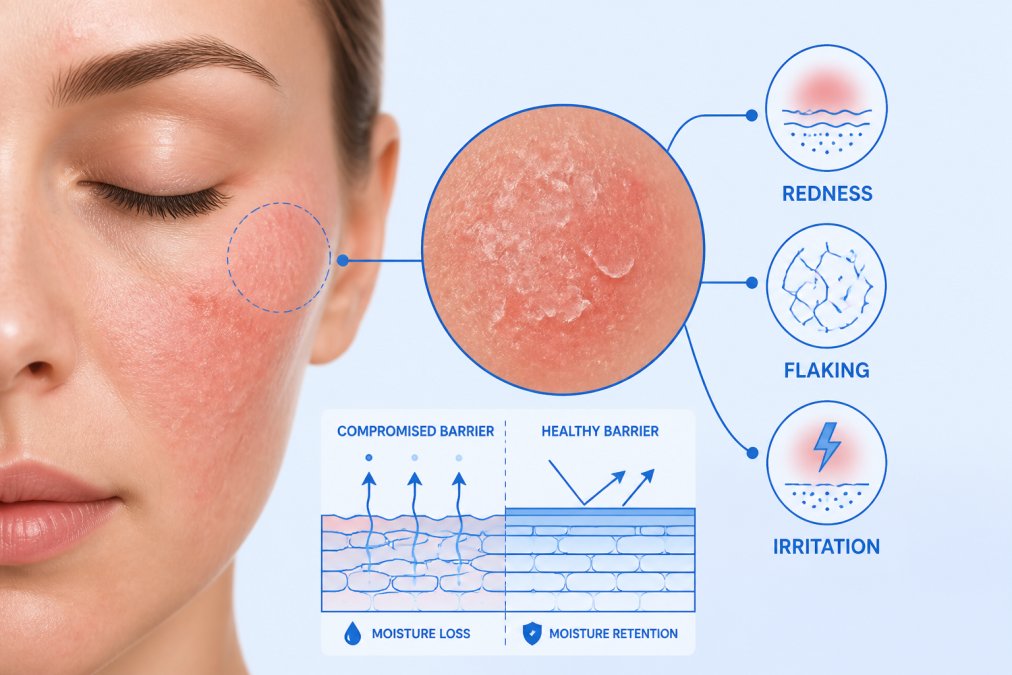
Visual and tactile warning signs
A compromised barrier typically shows: red or inflamed patches unresponsive to soothing ingredients, a sandpapery texture on cheeks or forehead, visible capillaries or rosacea-like flushing, and a persistent tight sensation immediately after applying moisturizer. Some describe it as their skin feeling "raw" or "reactive."
Run your finger across your cheekbone. Healthy skin feels smooth; a compromised barrier feels rough, bumpy, or slightly raised. This roughness is dead skin cells that aren't shedding properly because the barrier can't retain enough moisture to support normal desquamation.
How transepidermal water loss affects your skin
TEWL is the invisible culprit behind barrier breakdown. When ceramide levels drop, water evaporates from your skin at a rate 3-5 times higher than normal. This dehydration triggers a cascade: your skin becomes irritable, inflammation increases, your skin overproduces oil to compensate (creating a deceptive "oily but dehydrated" state), and the barrier weakens further. Ceramides reduce TEWL by sealing the intercellular gaps where water escapes.
What Damages Your Skin Barrier: Common Causes Beyond Genetics
Most barrier damage is caused by something you're doing or something in your environment, not genetics. Behavior determines whether your barrier thrives or collapses.
Over-exfoliation and active ingredient overuse
This is the number-one barrier killer. Exfoliating more than 2-3 times per week, layering multiple active ingredients on the same night, or using high-strength actives on already-sensitized skin strips away the protective lipid layer faster than your skin can regenerate it. Retinol is especially problematic during barrier compromise because it accelerates cell turnover, which is beneficial for healthy skin but catastrophic for damaged barriers. Barrier repair must come first, then actives later.
Environmental stressors and lifestyle triggers
Cold, dry air depletes ceramides, as does excessive heat, chlorine, hard water, and pollution. Lifestyle factors matter equally: dehydration, poor sleep, high stress, and inflammatory foods all impair barrier function. Many people focus entirely on topical skincare and ignore these triggers. Barrier repair takes 4-6 weeks because you're fighting multiple factors simultaneously.
How to Strengthen Your Skin Barrier with Ceramides and Lipids
Barrier repair requires precision. You need the right ceramide concentration, complementary lipids, and proper application method. Most people fail because they use a ceramide product designed for maintenance, not repair.
The ceramide-cholesterol-fatty acid ratio that actually works
Healthy skin contains ceramides, cholesterol, and fatty acids in a specific ratio: roughly 50:25:15 by weight. This ratio is critical. Ceramides alone don't repair the barrier; they need cholesterol to stabilize the lipid structure and fatty acids to fill gaps. A product with ceramides but no cholesterol is incomplete.
Look for formulations that explicitly list all three components. The Journal of the American Academy of Dermatology has published research confirming that products matching this 50:25:15 ratio show superior barrier repair compared to ceramide-only formulations. Aeran Skincare's Ceramide Barrier Night Cream ($36.00) includes all three at this ratio.

Delivery systems that matter: why formulation beats ingredient list
A ceramide product's formulation matters more than the ingredient list. Even the best ceramides won't repair your barrier if they're suspended in an emulsion that doesn't penetrate the stratum corneum. Occlusive creams work better than serums for barrier repair because they seal moisture in. Humectants like hyaluronic acid and glycerin draw water into the skin.
The best barrier-repair formulas use a combination approach: humectants to hydrate, ceramides and lipids to repair structure, and occlusives to seal everything in. This is why dermatologists often recommend layering a hydrating toner, a ceramide serum, and a barrier cream.
| Step | Product Type | Function | Timing |
|---|---|---|---|
| 1 | Hydrating Toner | Draws water into skin | Immediately after cleansing |
| 2 | Ceramide Serum | Repairs lipid structure | While skin is still damp |
| 3 | Barrier Cream | Seals moisture and lipids | Final step, morning or night |
Best Ceramides for Skin Barrier Repair: Choosing the Right Formula
Not all ceramides are created equal. The ceramide type, concentration, and formulation vehicle determine whether a product will actually repair your barrier.
Ceramide types and their specific functions
Ceramide NP (also called ceramide 3) is the most abundant ceramide in human skin and most important for barrier repair. If a product lists only one ceramide type, NP should be it. Ceramide AP (ceramide 6) supports skin elasticity. Ceramide EOP (ceramide 1) strengthens the barrier's outer layer.
The best barrier-repair products include all three types. When choosing a ceramide product, check the ingredient list: if you see "ceramide NP" listed separately from other ceramides, that's a good sign. If you see only "ceramides" without specification, the product likely contains a single type.
Essential complementary ingredients: hyaluronic acid, panthenol, and prebiotics
Hyaluronic acid (HA) is a humectant that holds up to 1000 times its weight in water. For barrier repair, HA works best in concentrations of 0.5-2%, applied to damp skin immediately after cleansing.
Panthenol (provitamin B5) reduces inflammation and supports barrier function without being occlusive. Prebiotics feed your skin's microbiome, increasingly recognized as essential for barrier health. The International Journal of Cosmetic Science has documented that prebiotic-enriched formulas improve barrier function faster than ceramide-only products.
Aeran Skincare's Bioactive Prebiotics Jelly Serum ($58.00) combines ceramides with prebiotics to support the skin's microbiome during barrier repair, addressing a gap most barrier creams miss.

Skin Barrier Repair Cream: Building Your Ceramide Routine
A barrier-repair routine is simpler than a normal skincare routine, but order matters. You're repairing one thing: your lipid barrier.
Layering order and timing for maximum absorption
The correct order is: cleanser → hydrating toner → ceramide serum (if using) → barrier cream → sunscreen (morning only). Apply your hydrating toner while your skin is still slightly damp from cleansing; this allows humectants to draw water into your skin. Wait 30-60 seconds, then apply your ceramide product. The slight dampness helps ceramides penetrate the stratum corneum more effectively.
Your barrier cream should be the last step before sunscreen. Creams are occlusive, meaning they seal everything in. If you apply serums after your cream, they won't penetrate.
Use your barrier-repair routine twice daily for at least 4 weeks. Many people see improvement by week 2, but true barrier repair takes 4-6 weeks because your skin needs time to regenerate ceramides naturally. Aeran Skincare's [Sensitive Skin Overnight Cream, Fragrance-Free](https://aeranskincare.com/products/sensitive-skin-overnight-cream-fragrance-free) ($28.95) is specifically designed for this phase.

What to avoid while your barrier heals
Stop using all active ingredients immediately, including retinol, vitamin C, AHAs, BHAs, and niacinamide above 5% concentration. These accelerate cell turnover, which is counterproductive when your barrier is already damaged. Resume actives after 4-6 weeks of barrier repair.
Avoid hot water, which strips ceramides faster than warm water. Avoid foaming cleansers, which are often too harsh for compromised skin. Avoid products with fragrance, essential oils, or alcohol. Avoid over-cleansing; once daily is sufficient during barrier repair.
Ceramide Sensitivity and Purging: What's Normal During Barrier Repair
Some people experience increased sensitivity or temporary breakouts when starting ceramide skincare. This is normal and usually resolves within 1-2 weeks.
Why some skin reacts initially to ceramide products
When you introduce ceramides to a severely compromised barrier, your skin is often inflamed and sensitized. The ceramides begin repairing the lipid structure, which can temporarily increase inflammation as your skin's immune system responds to healing. This is not an allergic reaction.
Additionally, ceramide products are often richer and more occlusive than what your skin is used to. Gradual introduction works better than jumping straight to a heavy cream. Start with a hydrating toner and ceramide serum, then add the barrier cream after 3-5 days.
Timeline: how long barrier repair actually takes
Week 1-2: Your skin may feel more irritated as inflammation increases temporarily. Redness may worsen before it improves. This is normal.
Week 2-3: Sensitivity begins to decrease. The tight, uncomfortable feeling starts to ease.
Week 4-6: Visible improvement in texture and redness. Your skin feels resilient again. Flaking and dryness resolve.
Week 6+: Your barrier is repaired. You can cautiously reintroduce actives if desired.
Some people see results by week 2; others take the full 6 weeks. This depends on how severely your barrier is damaged, your age, and whether you're addressing the lifestyle factors that caused the damage.
Common Misconceptions About Ceramide Skincare for Compromised Barriers
Myth 1: "All ceramide products are the same." A $15 ceramide product with a single ceramide type and no cholesterol or fatty acids will not repair your barrier the way a well-formulated ceramide cream will. A ceramide product should list ceramides, cholesterol, and fatty acids as primary ingredients.
Myth 2: "Ceramide products make you dependent on them." Your skin doesn't become "addicted" to ceramides. Once your barrier is repaired, you can reduce frequency to 2-3 times per week. Your skin produces its own ceramides; topical ceramides supplement what you're missing during repair.
Myth 3: "You should use ceramides forever." Once your barrier is healthy and you're protecting it from damage, you may only need ceramide products occasionally, during winter or after using actives.
Myth 4: "Ceramides are only for dry skin." Ceramides benefit all skin types. Oily skin can have a compromised barrier too. Oily skin needs lighter ceramide formulas (serums instead of heavy creams) and may benefit from pairing ceramides with lightweight hydrators like the Microbiome Prebiotics Face Mist ($22.00).
Myth 5: "Barrier repair takes weeks; if it's not working in days, the product is bad." Barrier repair is a biological process. You're literally rebuilding the lipid structure of your stratum corneum, which takes time. Give any barrier-repair routine at least 2 weeks before evaluating effectiveness.
A compromised skin barrier won't heal itself. It requires deliberate intervention with ceramide skincare designed specifically for repair. Aeran Skincare's barrier-first formulations include ceramides, cholesterol, and fatty acids at the ratios your skin actually needs, combined with complementary ingredients like prebiotics and panthenol. Start with the Hydrating Toner ($25.75) to establish hydration, layer with a ceramide serum, and seal with the Ceramide Barrier Night Cream ($36.00) for 4-6 weeks. You'll see your barrier repair, sensitivity fade, and your skin regain the resilience you thought you'd lost.
Frequently Asked Questions
What are the main signs of a compromised skin barrier?
A damaged skin barrier typically shows persistent redness, increased sensitivity to products, tight or uncomfortable skin, visible flaking or rough texture, and heightened reactivity to environmental triggers. You may also notice increased transepidermal water loss, which manifests as dehydration that doesn't improve with moisturizer alone. If your skin stings when applying normal products or feels inflamed without an obvious cause, your barrier likely needs repair.
How do ceramides repair a damaged skin barrier?
Ceramides are lipid molecules that fill gaps in the stratum corneum, the skin's outermost layer. They work alongside cholesterol and fatty acids to rebuild the intercellular lamellar lipids that hold skin cells together. This restored lipid bilayer reduces transepidermal water loss, strengthens skin homeostasis, and reduces inflammation and irritation. Ceramides essentially patch the microscopic cracks in your barrier, allowing your skin to retain moisture and protect itself from irritants.
How long does it take to repair a compromised skin barrier with ceramides?
Most people notice visible improvement within 2-4 weeks of consistent ceramide use, though complete barrier restoration typically takes 6-8 weeks. The timeline depends on barrier damage severity, your overall skincare routine, and whether you've eliminated the triggers that damaged it (like over-exfoliation). Patience is essential, rushing the process by adding actives too quickly can set back recovery. Night creams like the Ceramide Barrier Night Cream work during sleep when your skin naturally repairs itself.
Can I use ceramides with retinol, acids, or other active ingredients?
Not during initial barrier repair. While your skin barrier is compromised, focus exclusively on ceramides, humectants like hyaluronic acid, and soothing ingredients. Once your barrier is restored (typically 6-8 weeks), you can gradually reintroduce actives at lower concentrations and reduced frequency. When you do reintroduce them, use ceramide products as a buffer, apply your active first, then layer a ceramide cream on top to minimize irritation and support barrier function.
What causes a compromised skin barrier beyond genetics?
Over-exfoliation is the most common culprit, whether from physical scrubs, chemical exfoliants, or using them too frequently. Other major causes include harsh cleansers that strip natural oils, environmental stressors like extreme heat or cold, pollution, low humidity, and frequent use of irritating products. Lifestyle factors matter too: stress, poor sleep, dehydration, and excessive alcohol consumption all weaken barrier function. Even some skincare ingredients like high concentrations of fragrance or certain preservatives can trigger barrier damage in sensitive skin.
What ingredients should I pair with ceramides for best results?
Ceramides work best alongside cholesterol and fatty acids in a balanced ratio, plus humectants like hyaluronic acid and panthenol that draw moisture into the skin. Prebiotics support your skin's microbiome, which is essential for barrier health. Aloe and algae have soothing properties that reduce inflammation during repair. Avoid pairing ceramides with strong actives (retinol, vitamin C, acids) during the repair phase. Products like the Bioactive Prebiotics Jelly Serum complement ceramide creams by nourishing your skin's natural ecosystem.
Is ceramide sensitivity or purging normal when starting barrier repair?
Some initial sensitivity is possible, especially if your skin is already reactive. However, true purging from ceramides is rare, they're gentle, non-comedogenic ingredients. If you experience stinging, burning, or increased breakouts, it may indicate the product contains other irritating ingredients. Start with a small amount, use every other night initially, and introduce one new ceramide product at a time. If irritation persists after one week, stop and consult a dermatologist. Fragrance-free formulas like the Sensitive Skin Overnight Cream minimize the risk of adverse reactions.
This article was written using GrandRanker