


Clean Beauty for Reactive Skin: A 2026 Guide
Table of Contents
- Understanding Reactive Skin and Clean Beauty
- Clean Beauty Ingredients to Avoid for Sensitive Skin
- How to Identify Reactive Skin Triggers
- Building a Soothing Skincare Routine for Reactive Skin
Last Updated: August 13, 2026
Understanding Reactive Skin and Clean Beauty
Reactive skin stems from a compromised barrier that overreacts to stimuli most people tolerate, redness after moisturizer, stinging from fragrance, or unexplained irritation. At Aeran Skincare, we understand that reactive skin isn't a flaw; it's a signal that your barrier needs support, not aggression.

Clean beauty for reactive skin means choosing formulations that work WITH your skin's natural defenses rather than against them. For reactive skin, you need formulations built on barrier repair first, visible results second.
This guide covers what reactive skin actually needs, which ingredients amplify the problem, how to identify your personal triggers, and how to build a routine that genuinely calms instead of complicating.
Clean Beauty Ingredients to Avoid for Sensitive Skin
Fragrance and essential oils top the list. Even "natural" essential oils like lavender and tea tree are potent irritants for reactive skin. Look for products labeled "fragrance-free" and check ingredient lists for "parfum" or specific essential oil names.
High-concentration exfoliants, both chemical and physical, strip the barrier when used on reactive skin. Glycolic acid, salicylic acid, and benzoyl peroxide are effective for many skin types, but reactive skin often needs gentler approaches. Enzymatic exfoliation or lower concentrations (under 5%) are safer starting points.
Denatured alcohol (listed as "alcohol denat") evaporates moisture rapidly, leaving your barrier vulnerable. Avoid products where alcohol appears in the first five ingredients.
Synthetic preservatives like methylisothiazolinone (MIT) and high-concentration parabens trigger sensitivity in many people. Reactive skin often responds better to gentler preservation systems or natural preservation methods.
Silicones and heavy occlusives can trap bacteria and sweat against reactive skin. Lighter hydrators like hyaluronic acid and squalane typically work better.
FDA guidance on cosmetic ingredients and safety
How to Identify Reactive Skin Triggers
Reactive skin flares for specific reasons. Finding yours requires systematic observation.
Start a trigger log. When your skin reacts, note what you applied in the past 24 hours, stress level, sleep quality, and environmental factors like humidity or temperature. Most people assume it's always the product, but reactive skin responds to the full context.
Patch testing is non-negotiable. Apply a new product to a small area behind your ear or on your inner arm first. Wait 24-48 hours. If no reaction occurs, try it on a small facial area for another 2-3 days before full integration.
Environmental triggers matter as much as product triggers. Cold, dry air dehydrates the barrier and increases reactivity. High humidity can trap bacteria and trigger flare-ups. Pollution, chlorine, and hard water all stress reactive skin.
Ingredient concentration and formulation pH affect reactivity more than the ingredient itself. A 2% salicylic acid toner might work fine; a 10% treatment will likely cause problems. A pH-balanced cleanser (around 5.5) feels soothing, while an alkaline one (pH 8+) strips and irritates.
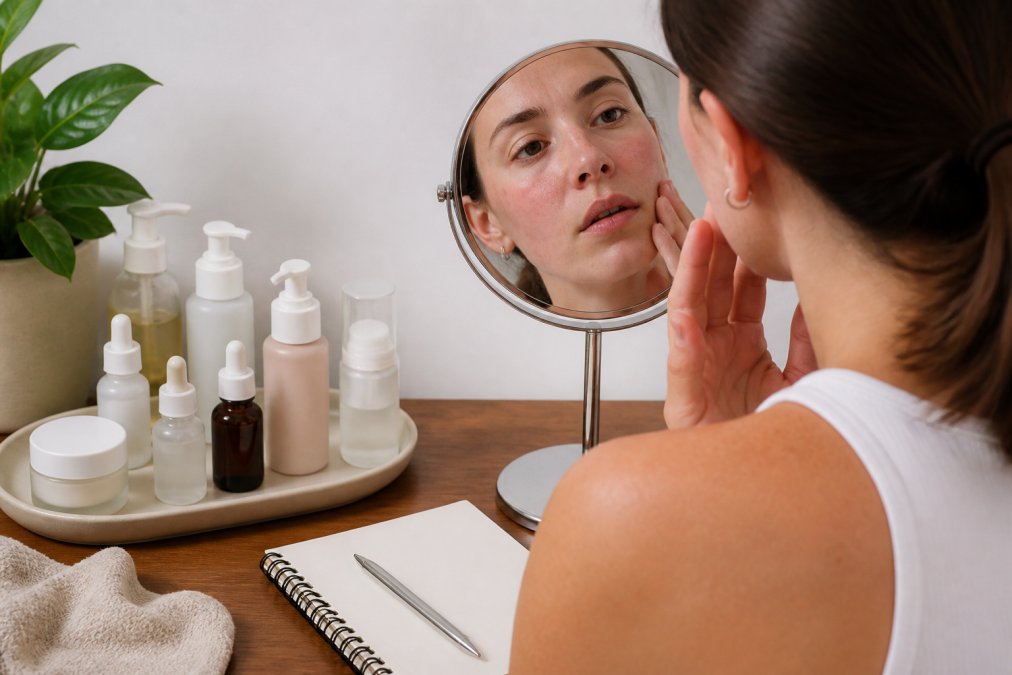
Timing patterns reveal triggers too. If your skin reacts within minutes of application, it's usually the product. If it reacts 6-12 hours later, it might be environmental or dietary. If it reacts the next morning, sleep position or pillow material could be involved.
Building a Soothing Skincare Routine for Reactive Skin
A routine for reactive skin prioritizes barrier support, hydration, and minimal irritation. Complexity is the enemy here.
Step 1: Cleanse gently. Use a fragrance-free, pH-balanced cleanser that removes makeup and dirt without stripping. The Aeran Skincare Oil-To-Milk Cleanser ($34.95) transforms from oil to milk upon contact with water, removing impurities while maintaining the barrier.

Step 2: Hydrate immediately. After cleansing, apply hydration while skin is still slightly damp. The Aeran Skincare Hydrating Toner ($25.75) restores pH balance and delivers hyaluronic acid, which binds moisture to the skin.
Step 3: Apply targeted serums. The Aeran Skincare Bioactive Prebiotics Jelly Serum ($58.00) supports the skin's microbiome, the beneficial bacteria that strengthen your barrier, while delivering deep hydration.
Step 4: Moisturize with barrier support. Ceramides are lipids that form the barrier's structure. The Aeran Skincare Ceramide Barrier Night Cream ($36.00) delivers ceramides alongside hyaluronic acid and aloe, directly repairing what reactive skin has lost.
Step 5: Protect and refresh. During the day, the Aeran Skincare Microbiome Prebiotics Face Mist ($22.00) provides a midday hydration boost without disrupting makeup.
| Step | Product Focus | Frequency | Why It Matters |
|---|---|---|---|
| Cleanse | Fragrance-free, pH-balanced | Twice daily | Removes irritants without stripping barrier |
| Hydrate | Hydrating toner with hyaluronic acid | Twice daily | Restores pH and locks in moisture |
| Treat | Prebiotics or gentle serum | Once or twice daily | Supports microbiome and barrier strength |
| Moisturize | Ceramide-rich cream | Evening (daily) | Repairs barrier structure while you sleep |
| Refresh | Face mist with prebiotics | As needed | Maintains hydration without disruption |
Start simple. Begin with cleanser, hydrating toner, and a good moisturizer. Once your barrier stabilizes (usually 4-6 weeks), introduce one additional product at a time. Consistency matters more than complexity, a simple routine used daily outperforms an elaborate one used sporadically.
The challenge with reactive skin is that it punishes experimentation. The solution isn't more products, it's understanding your barrier's specific needs and choosing formulations built to support it. Aeran Skincare's barrier-first approach and ceramide-rich formulations address exactly what reactive skin requires: clean ingredients, microbiome support, and visible results without irritation. Start with the foundational routine, patch test new additions, and give your barrier time to heal. You'll notice the difference within weeks.
Frequently Asked Questions
How can I tell if my skin is truly reactive or just sensitive?
Reactive skin flares up suddenly in response to specific triggers, products, weather, stress, or pollution, causing visible redness, stinging, or inflammation that appears and disappears. Sensitive skin is chronically easily irritated by many products. Reactive skin often has normal periods between flare-ups. Track when your skin reacts to identify patterns. If you notice sudden redness or burning after applying a product, or your skin worsens during high-pollen seasons, you likely have reactive skin. A dermatologist can confirm the distinction and rule out conditions like rosacea.
What clean beauty ingredients actually calm reactive skin flare-ups?
Ceramides rebuild your skin barrier and reduce inflammation, they're among the most effective ingredients for reactive skin. Hyaluronic acid hydrates without irritation. Aloe vera and colloidal oatmeal soothe redness and irritation. Prebiotics support your skin's microbiome, which strengthens your barrier's natural defense. Avoid essential oils, fragrance, and high-concentration exfoliants. Look for products labeled hypoallergenic, fragrance-free, and dermatologist-tested. Aeran's Ceramide Barrier Night Cream ($36.00) delivers ceramides directly into your skin's lipid layer, while the Bioactive Prebiotics Jelly Serum ($58.00) nourishes your skin's protective microbiome.
How long does it take for a clean beauty routine to calm reactive skin?
Most people see visible improvement in redness and irritation within 2-4 weeks of consistent use, though full barrier repair can take 6-8 weeks. Avoid switching products frequently, give each one at least 3-4 weeks before evaluating results. Reactive skin responds well to microbiome-supporting ingredients and barrier-strengthening ceramides, but patience is essential. If your skin worsens after two weeks, you may have identified a trigger ingredient. Keep a simple routine during the adjustment phase: cleanse, hydrate, moisturize, and patch-test new products on a small area first.
Can I use anti-aging products if I have reactive skin?
Yes, but choose gentle alternatives to traditional retinol. Bidens Pilosa extract delivers retinol-like results without the irritation, redness, or peeling that triggers reactive skin flare-ups. Aeran's Retinol Alternative Serum ($35.00) and Retinol Alternative Moisturizer ($23.75) use this clinically studied botanical to reduce fine lines and improve texture safely. Pair anti-aging products with barrier-supporting ceramides and avoid combining them with other actives initially. Always use SPF during the day, and introduce anti-aging products slowly, start 2-3 times weekly, then increase frequency as your skin adapts.