


How to Transition to a Fragrance-Free Skincare Routine
Table of Contents
- Why Your Skin May Need a Fragrance-Free Skincare Routine
- Fragrance-Free vs Unscented Skincare: What the Labels Really Mean
- How to Read Skincare Ingredient Labels for Hidden Fragrance
- How to Patch Test New Skincare Products
- The Step-by-Step Transition Plan
- The Withdrawal Period Nobody Warns You About
- The Environmental Fragrance Audit
- Building a Basic Fragrance-Free Routine
- When to See a Dermatologist
- Frequently Asked Questions
Last Updated: September 11, 2026
Why Your Skin May Need a Fragrance-Free Skincare Routine
If your skin stings, reddens, or flares after applying a product, fragrance is a prime suspect. Transitioning to a fragrance-free skincare routine is often the most effective step for reactive, dry, or compromised skin. At Aeran Skincare, every formula is barrier-first, Scandinavian-formulated, and free of added scent.
Fragrance is the most common cause of allergic contact dermatitis from cosmetics, according to the American Academy of Dermatology. Reactions can be subtle, low-grade redness, stubborn dryness, or stinging minutes after application, and accumulate with repeated exposure, so many people blame "sensitive skin" when the real culprit hides behind a vague label.
Fragrance-Free vs Unscented Skincare: What the Labels Really Mean
Fragrance-free means no fragrance was added. Unscented means masking agents may be present, and those can still trigger reactions.
An "unscented" bottle can legally contain a fragrance compound whose only job is to mask raw-ingredient odor. "Natural" fragrance is no safer: essential oils and botanical extracts often contain the same allergenic molecules as synthetic fragrance.
| Label Term | What It Means | Risk for Reactive Skin |
|---|---|---|
| Fragrance-free | No fragrance added, including masking agents | Lowest |
| Unscented | May contain masking fragrance to hide odor | Moderate to high |
| Natural fragrance | Scent from essential oils or botanicals | Variable, often high |
For reactive skin, treat "fragrance-free" as the only label that answers the question.
How to Read Skincare Ingredient Labels for Hidden Fragrance
Scan the full ingredient list, not the front of the package, for "fragrance," "parfum," "aroma," and essential oils like limonene, linalool, and citronellol.
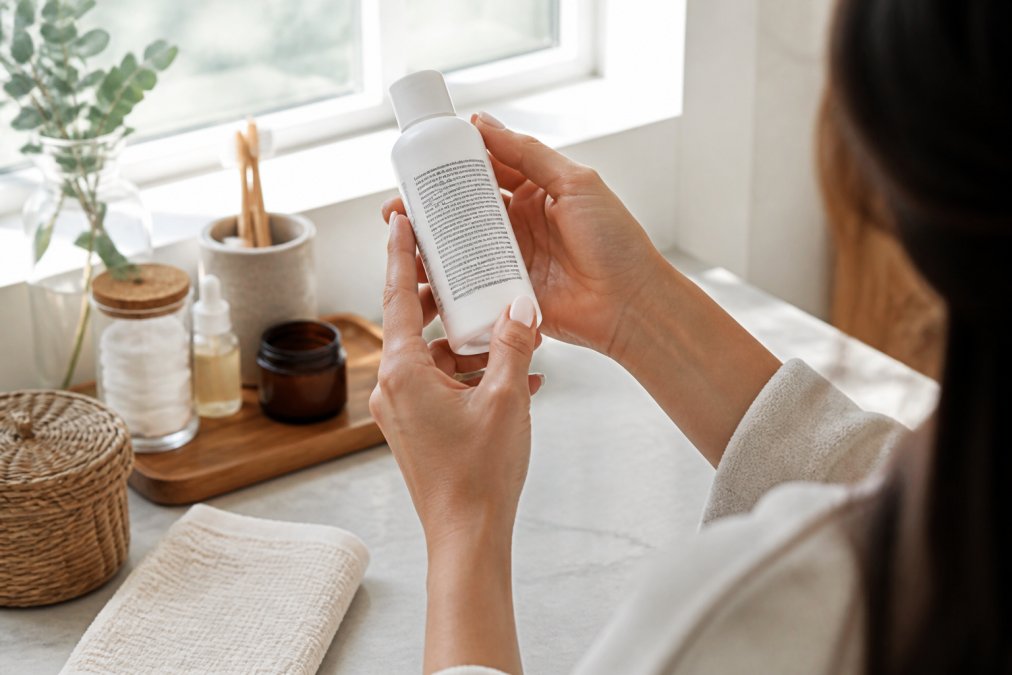
The front of the bottle is marketing; the ingredient list is the truth. US rules require descending order of concentration, and fragrance usually appears as one catch-all term whose contents need not be disclosed. Watch for "fragrance" or "parfum," "aroma," essential oils (lavender, citrus, peppermint, eucalyptus, tea tree), individual allergens (limonene, linalool, citronellol, geraniol, eugenol), and botanical extracts that carry scent compounds. Shortcut: if a product smells like anything, something is producing that scent.
How to Patch Test New Skincare Products
Patch testing is the only reliable way to confirm whether a product irritates your skin before committing it to your whole face.
The standard approach, recommended by dermatologists at the Cleveland Clinic, is to apply a dime-sized amount behind your ear or on the inner forearm, twice daily for several days, then repeat on a small patch of your jawline before using it across your full face. Two common mistakes: testing for a single day (contact dermatitis can take 48 to 72 hours to appear) and testing a new product while still using an old suspect (peer-reviewed research).
The Step-by-Step Transition Plan
Transition in stages, replacing one product at a time to isolate what helps. A typical transition takes four to six weeks.
Step 1: Audit what you own. Read every ingredient list and sort products into clearly fragranced, possibly fragranced, and fragrance-free.
Step 2: Replace leave-on products first. Moisturizers, serums, and facial oils sit on skin for hours and cause more reactions than rinse-offs.
Step 3: Replace cleansers and toners next. Choose pH-balanced, non-comedogenic formulas.
Step 4: Rebuild your barrier. Ceramides, hyaluronic acid, and niacinamide support repair; a simple cleanser, moisturizer, and sunscreen routine is enough.

Step 5: Hold the line for four weeks. Barrier recovery is slow, and early weeks can look worse before they look better.
| Step | Action | Timeframe |
|---|---|---|
| 1 | Audit current products | Week 1 |
| 2 | Replace leave-on products | Weeks 1-2 |
| 3 | Replace cleansers and toners | Weeks 2-3 |
The Withdrawal Period Nobody Warns You About
Your skin can get worse before it gets better. Removing a fragrance that masked underlying irritation makes suppressed inflammation visible, so the first week or two can bring more redness, not less, the biggest reason people abandon the switch.
What helps: expect it, keep the routine boring (no new actives), support the barrier with ceramides and humectants, and give it two to three weeks. If a reaction is severe, spreading, or accompanied by swelling, stop and see a dermatologist.
The Environmental Fragrance Audit
Fragrance reaches your skin from more than skincare: laundry detergent, fabric softener, dryer sheets, shampoo, body wash, hair products, and perfume all land on or near your face. If switching moisturizer changes nothing, the trigger may be in your laundry room.
Audit everything that touches your skin. Many find a fragrance-free laundry detergent does more for facial redness than any single skincare change.
Building a Basic Fragrance-Free Routine
A fragrance-free routine need not be complicated. Three products used consistently outperform a ten-step routine full of potential irritants.
Cleanser. Gentle and pH-balanced; if skin feels tight after washing, it is too harsh.
Moisturizer. Where barrier repair happens. Look for ceramides, lipids compromised skin tends to lack; a fragrance-free night cream with ceramides and hyaluronic acid supports overnight renewal.
Sunscreen. Non-negotiable: UV worsens inflammation and slows barrier recovery. Choose fragrance-free, mineral-based if your skin reacts to chemical filters.
Oily or combination skin: a salicylic acid toner a few times weekly manages breakouts without fragrance. Dry or reactive skin: a hydrating toner under moisturizer adds water without weight.
Aeran Skincare builds its range around this approach. The Calm Night Cream is fragrance-free, with algae, aloe juice, and hyaluronic acid to calm redness-prone skin overnight. The Exosomes + Niacinamide Serum pairs barrier-supporting niacinamide with apple extract-infused exosomes for dullness and early fine lines. Both suit sensitive, reactive, compromised skin.

When to See a Dermatologist
Persistent redness, swelling, blistering, or a rash spreading beyond the application site needs professional attention. Dermatologist patch testing can identify specific allergens, including fragrance compounds, you would never isolate alone.
For most people the process is simpler: remove the fragrance, support the barrier, give it a month, and watch what changes. Skin recovers remarkably once the irritant is gone.
Fragrance is the most overlooked cause of persistent skin irritation, and removing it often separates a routine that fights your skin from one that works with it. Aeran Skincare formulates every product around that idea: barrier-first, Scandinavian-formulated, and made with clean ingredients including ceramides, so sensitive, dry, and compromised skin gets support instead of another trigger. Explore the Calm Night Cream for overnight barrier repair, or start with the Exosomes + Niacinamide Serum if dullness and fine lines are your focus. Get started with Aeran Skincare and give your skin the fragrance-free foundation it has been asking for.
Frequently Asked Questions
Is fragrance-free the same as unscented?
No. Unscented products may still contain masking agents or synthetic fragrance to cover the smell of raw ingredients, while fragrance-free means no fragrance has been added at all. If your skin reacts to scent, look for the term fragrance-free on the label and scan the ingredient list for parfum, aroma, or masking agents. Choosing fragrance-free skincare avoids the hidden scent compounds that often trigger redness, stinging, or contact dermatitis.
How long does it take for skin to recover after removing fragrance?
Many people notice less stinging and redness within one to two weeks of switching to a fragrance-free skincare routine, but full barrier recovery can take four to six weeks. During this adjustment period, keep your routine simple: a gentle cleanser, a hydrating toner, and a ceramide-rich moisturizer. If irritation persists past six weeks or worsens, see a dermatologist to rule out other triggers like essential oils or preservatives.
How do I know if my skincare products contain hidden fragrances?
Read the full ingredient list, not just the front label. Fragrance hides behind terms like parfum, aroma, essential oils, botanical extracts, and masking agents. Products labeled natural or clean are not automatically fragrance-free. When learning how to read skincare ingredient labels, check the last third of the list where fragrance and preservatives usually appear. If you see any of these terms and your skin is reactive, set the product aside.