


How to Identify Harmful Ingredients in Face Wash
Table of Contents
- Common Toxic Ingredients in Skincare to Avoid in Face Wash
- How to Read Skincare Labels: A Step-by-Step Label Check
- Skincare Ingredient Checker Tools and Skin-Type Risk Factors
- Frequently Asked Questions
Last Updated: September 16, 2026
Common Toxic Ingredients in Skincare to Avoid in Face Wash
Identifying harmful ingredients in face wash starts with knowing which harmful ingredients deserve scrutiny. This Aeran Skincare guide breaks down what to look for on any label.
Sodium lauryl sulfate (SLS) is a surfactant that creates rich lather but strips the skin barrier. Parabens are endocrine-disrupting preservatives (pubmed.ncbi.nlm.nih.gov). Phthalates hide inside synthetic fragrance. Formaldehyde releasers emit chemical irritants over time. Mineral oil and siloxanes can clog pores for acne-prone skin.
| Ingredient Category | Common Names | Primary Risk |
|---|---|---|
| Surfactants | SLS, SLES | Barrier stripping |
| Preservatives | Parabens, formaldehyde releasers | Endocrine disruption, contact dermatitis |
| Fragrance | Synthetic fragrance, phthalates | Allergic reactions |
How to Read Skincare Labels: A Step-by-Step Label Check
Scan the first five ingredients, where concentration is highest, then the last few for preservatives and fragrance.
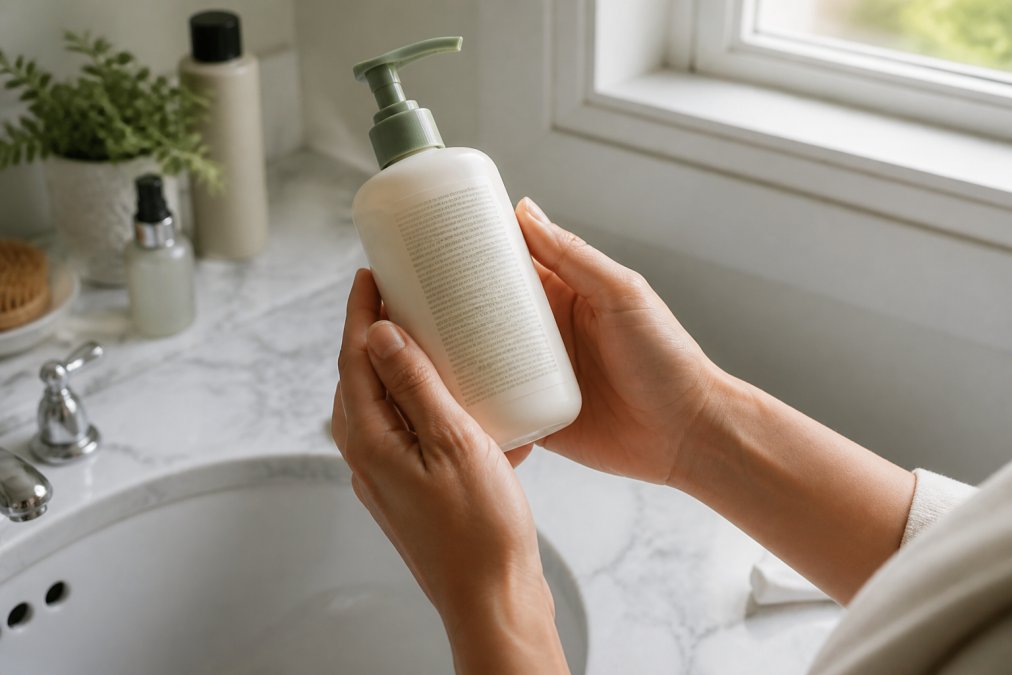
- Check the first five ingredients for surfactants and active compounds
- Scan the middle for preservatives and pH adjusters like potassium hydroxide
- Read the final lines for synthetic fragrance and allergen declarations
- Cross-reference each term against a trusted ingredient decoder
- Patch test new formulas on your inner forearm for 48 hours
According to FDA guidance on cosmetics labeling, ingredients must be listed in descending order of concentration, which makes label analysis far more reliable than marketing claims.
Skincare Ingredient Checker Tools and Skin-Type Risk Factors
Skincare ingredient checker tools flag chemical irritants, comedogenic ratings, and endocrine disruptors from a pasted INCI list, best paired with an honest skin-type assessment.
Dry, compromised skin reacts hardest to surfactants and alcohol; oily skin to mineral oil and heavy siloxanes; sensitive skin needs hypoallergenic formulas without synthetic fragrance.
Clean beauty avoids certain ingredient classes outright; science-backed formulation evaluates each ingredient's toxicity and dermal absorption individually. Neither label guarantees safety alone.
Cosmetic Ingredient Review safety assessments publishes independent toxicology reviews that cut through greenwashing claims on either side.
Finding a face wash that won't wreck your skin barrier is hard when labels promise everything and deliver irritation. Aeran Skincare builds barrier-first, Scandinavian-formulated cleansers with clean ingredients and ceramides for sensitive, dry, and compromised skin. The Calm Foam Wash uses calendula, chamomile, and a low-lather formula that cleanses without stripping. Get started with Aeran Skincare and give your skin a cleanser that supports its barrier instead of fighting it.

Frequently Asked Questions
What ingredients should I avoid in a face wash?
Start with sulfates like sodium lauryl sulfate, which strip the skin barrier and leave it tight. Watch for parabens, phthalates, formaldehyde releasers, and synthetic fragrance, all linked to irritation or endocrine disruption. Propylene glycol and potassium hydroxide can trigger reactions on sensitive skin. If you have reactive or compromised skin, a low-lather, fragrance-free cleanser with calming botanicals is the safer choice.
How can skincare ingredient checker tools help me spot harmful ingredients?
Skincare ingredient checker tools let you paste or scan an ingredient list and flag known irritants, allergens, and endocrine disruptors. They save time on long INCI names you do not recognize. Use them as a first pass, not a final verdict: a flagged ingredient may still be safe at low concentrations. Cross-check the label yourself and patch test before committing to a full-size product.
Are sulfates and parabens really bad for your skin?
It depends on your skin type and the concentration. Sulfates like sodium lauryl sulfate remove oil effectively but can strip the skin barrier, causing tightness and redness on dry or sensitive skin. Parabens are preservatives that keep formulas free of mold and bacteria; some studies link them to endocrine disruption, though regulators consider them safe at current limits. If your skin reacts easily, choose sulfate-free, paraben-free formulas.